
Renewable Energy Was – and Should Continue to Be – at the Core of Earth Day

Written by Anastasia Smolentseva, Senior Director, Communications at Marine Renewables Canada
Earth Day began with a movement.
On April 22, 1970, millions of people across the United States took to the streets, campuses, and communities to demand a different path forward – one that respected the environment and recognized the growing impact of pollution on both human health and the planet. It became one of the largest civic demonstrations in history and helped spark what we now know as the modern environmental movement.
At the center of that first Earth Day was Denis Hayes, a young organizer who would go on to spend his career championing renewable energy. In many ways, the solutions we’re talking about today are exactly what that first Earth Day was pointing toward.

More than 50 years later, the message feels even more urgent.
In 2026, the theme “Our Power, Our Planet” really lands. Because the power we choose today will shape the future of every ecosystem, every coastline, every community – and every species that calls this planet home.
Climate change is here. It’s warming our oceans, intensifying storms, and putting real pressure on the natural systems we depend on. From large metropolitan areas to remote regions, no one is untouched.
But there is also a real opportunity here. One that rises with the tides, flows with the waves, and turns with the wind.
Working with Nature
Marine renewable energy – offshore wind, tidal, wave, and river current – is deeply connected to the natural rhythms of the planet. And with coastlines spanning three oceans, Canada is uniquely positioned: it’s home to some of the world’s strongest tides, powerful offshore winds, and abundant wave resources. Inland, we have more than 8,500 named rivers – and countless smaller waterways.
Technologies to harness this power already exist. And around the world, including in Canada, they have been tested, refined, and proven to work with nature.
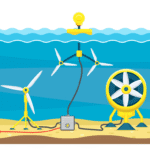
Tidal energy (tidal stream) |
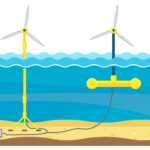
Offshore wind energy |

Wave energy |

River current (hydrokinetic) energy |
Protecting the environment isn’t separate from developing energy – it has to be built into it. Marine renewable projects go through rigorous environmental assessments and ongoing monitoring, and the research continues to evolve.
The goal is simple: to generate abundant, renewable, and low-emission energy while protecting ocean and river health and biodiversity.
Why Marine Renewables?
Canada is facing a challenge that a lot of countries are grappling with right now:
1. Electricity demand is expected to double or even triple by 2050;
2. Approximately 280 remote and Indigenous communities rely primarily on costly diesel and other fossil fuels for power, despite being located near abundant marine energy resources;
3. Canada has committed to a clean electricity system by 2050;
4. Canadians expect electricity to be affordable, reliable, and environmentally responsible;
5. And energy security is becoming an increasingly important and uncertain factor.
Existing sources like hydropower, nuclear, wind, and solar will remain foundational. But meeting future demand at scale will require a broader mix of solutions.
This is where marine renewables come in.
I often think about this way: building a resilient energy system is not unlike building a high-performing team – you don’t rely on just a few strengths; you bring in the best talent to complement and elevate the entire system. And as technologies advance, it makes little sense to limit ourselves to what we already know when new solutions can strengthen reliability, expand capacity, and unlock economic opportunities across Canada’s regions and the country as a whole.

Powering Communities and Protecting Our Future
Offshore wind and tidal energy have major utility-scale potential, especially in Atlantic Canada. At the same time, wave energy in British Columbia and river current technologies in places like Manitoba offer practical, local solutions for Indigenous, coastal, and remote communities that want to move away from diesel.
That shift matters. It means lower emissions, more energy independence, and real opportunities for long-term economic participation – especially when projects are built in partnership with communities and grounded in shared stewardship of the ocean.
And there’s real momentum.
Nova Scotia’s commitment to license up to 5 GW of offshore wind by 2030 is a big signal of where things are heading. Tidal energy is also advancing in the Bay of Fundy, where companies like Orbital Marine Power are continuing to push technology forward in one of the most powerful tidal environments in the world.
Globally, marine renewables are scaling quickly – and Canada has everything it needs to be a leader.
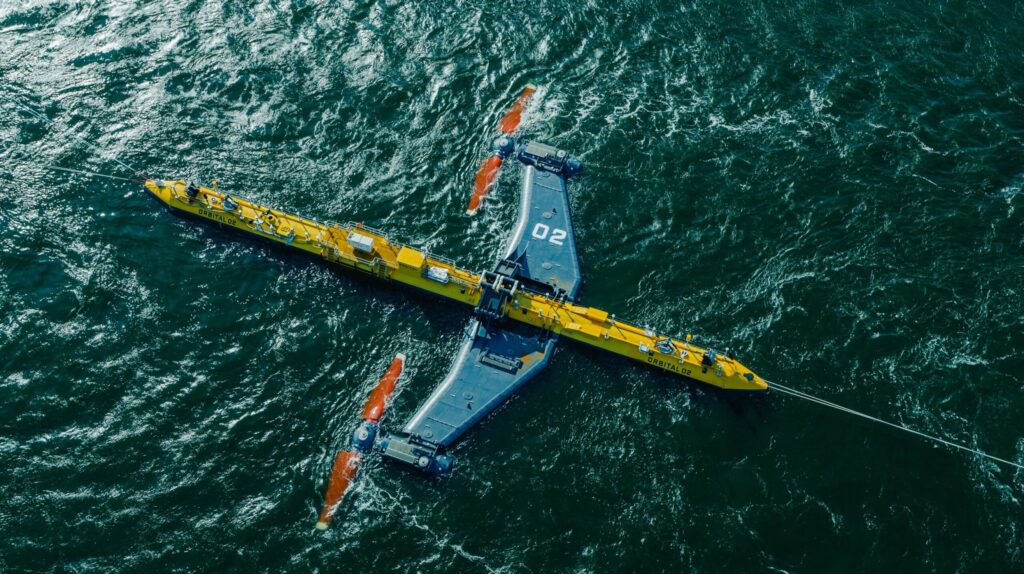
Photo: Orbital O2, Orbital Marine Power
Marine Renewable Energy Sector Vision 2050
At Marine Renewables Canada, a big part of our work is helping turn this potential into something real.
We recently released the Marine Renewable Energy Sector Vision 2050 as our roadmap, laying out the technologies, opportunities, and steps needed to scale this sector across the country.
It’s not just about energy. It’s about connecting climate action with economic growth and building a future where Canada is a global leader in ocean-based clean energy.
(And if you’re not in the mood to read the full report – we’ve got a shorter brochure too.)
Renewable Energy Was – and Should Continue to Be – at the Core of Earth Day
As EarthDay.org website reads: “Progress does not happen in silence. It happens when people show up. Environmental progress is built through everyday action – from communities protecting ecosystems to innovators advancing solutions. Clean air, safe water, and climate resilience aren’t optional – they’re essential.”
And I can tell you with certainty, Canada’s marine renewables sector is showing up in a big way.