
Offshore Wind Energy
What is Offshore Wind Energy?
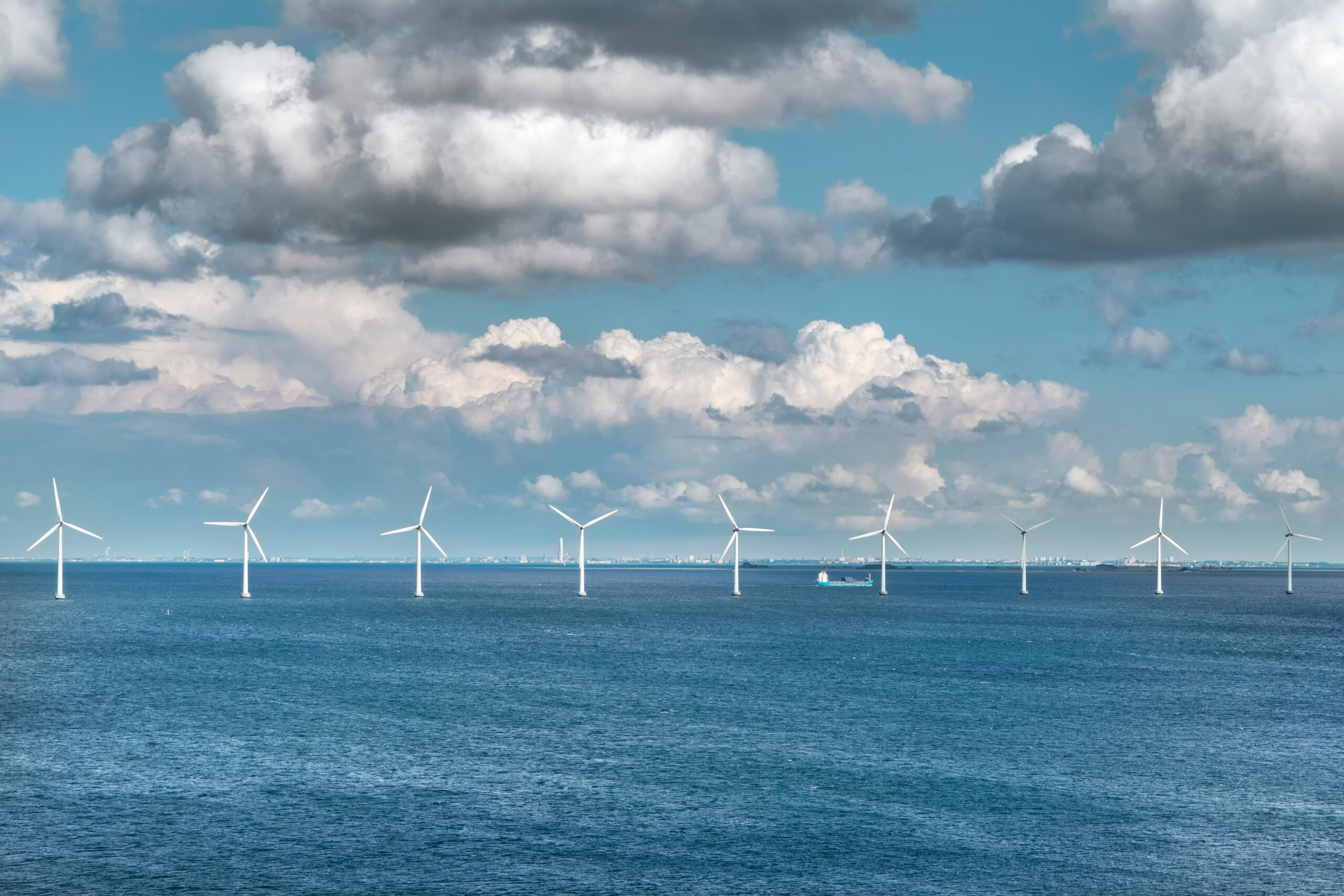
Offshore wind energy is a way to produce electricity using large wind turbines placed in the ocean or other large bodies of water, such as the Great Lakes.
Winds over water are usually stronger and more consistent than winds on land. That makes offshore turbines especially good at generating clean power.
Like land-based turbines, offshore turbines work when wind turns the blades. The blades spin a rotor, and that motion is converted into electricity.
Land vs Offshore Wind
Wind energy works both on land and at sea, but offshore wind offers some distinct advantages due to ocean conditions and technology scale.
Bigger turbines, more power
Typical onshore wind turbines generate about 2-6 megawatts (MW) of electricity, while offshore turbines usually produce 8-15 MW each. As technology advances, turbines continue to grow: in January 2026, a 20 MW offshore wind turbine was installed off the coast of southern Fujian, China, as part of a research project – demonstrating the direction of future development.
Stronger winds over water
Wind generally blows faster and more consistently over open water than over land. Even small increases in wind speed can lead to much higher electricity generation, because the power produced by a turbine rises rapidly as wind speed increases.
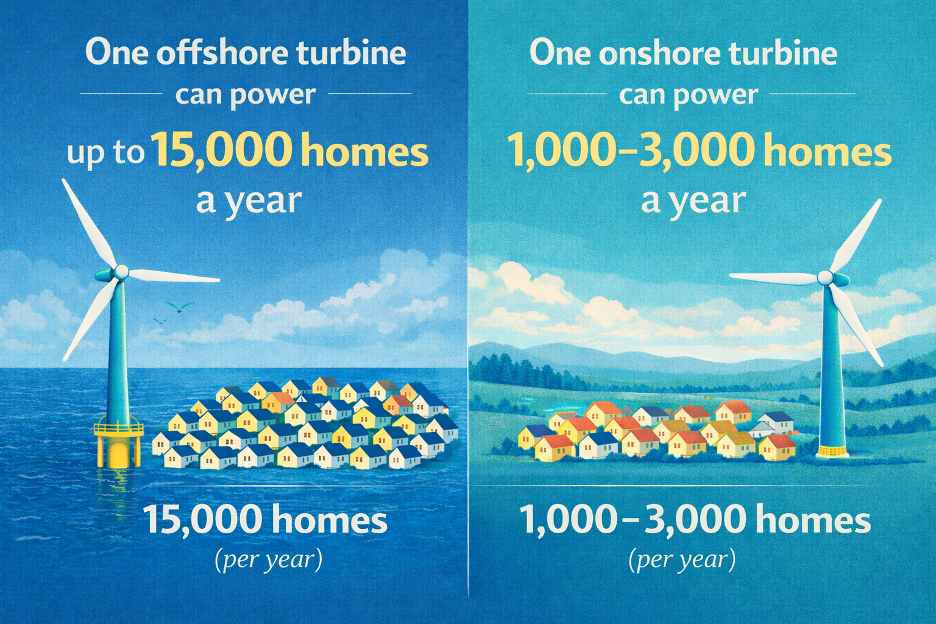
One offshore turbine can power up to 15,000 homes a year, compared with 1,000-3,000 homes for a single onshore turbine (U.S. Department of Energy).
More reliable and predictable energy
Offshore wind patterns are often steadier and can be forecast several days in advance. This predictability helps electricity system operators plan for a more stable and reliable power supply.
Easier to build at large scale
Transporting large turbine components by ship is easier than moving them along roads or through communities. This makes it possible to install much larger turbines offshore than on land, increasing power output while reducing the number of turbines needed.
Together, these factors mean offshore wind can generate large amounts of clean, reliable electricity, making it a strong complement to onshore wind and other renewables in meeting growing energy needs.
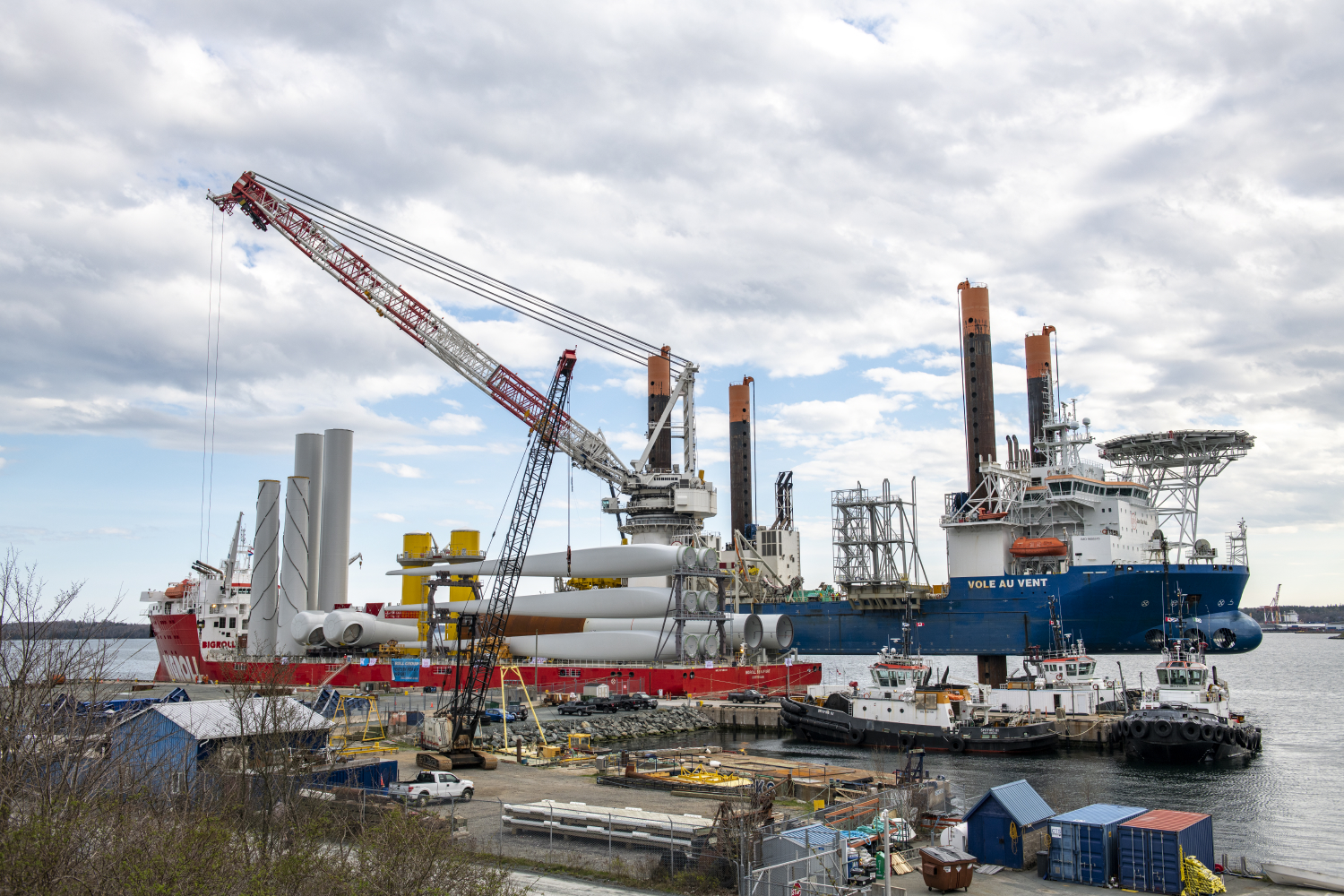 Source: Port of Halifax, Nova Scotia, Canada
Offshore Wind Technology 101
Offshore wind turbines have advanced quickly over the last 30 years. Innovation has focused on:
- building larger turbines that can produce more electricity,
- improving foundation systems,
- reducing environmental impacts,
- and limiting conflicts with other ocean users.
There are two main foundation types:
- Fixed-bottom turbines
These are anchored directly to the seabed and are best suited for waters up to about 70 metres deep. They are the most common type today.
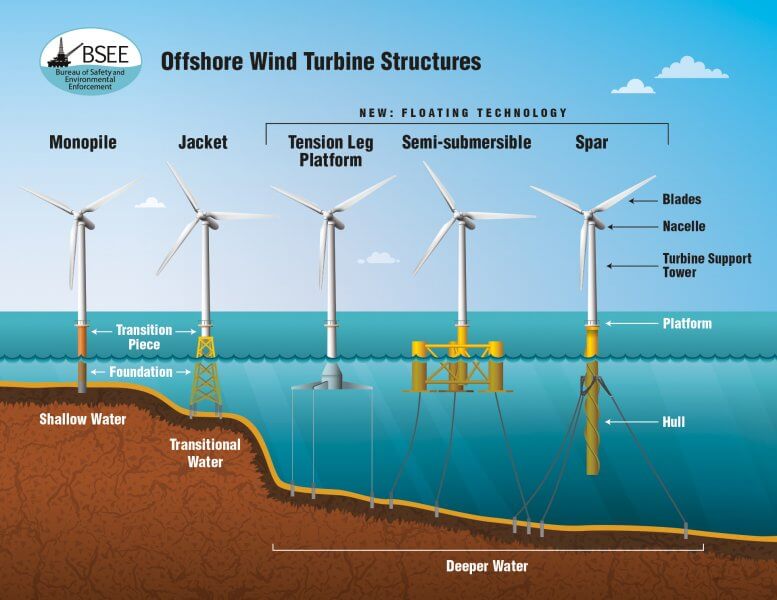
Source: Windpower Engineering & Development, https://www.windpowerengineering.com/ready-to-float-a-permanent-cost-reduction-for-offshore-wind/
- Floating turbines
Floating turbines sit on platforms held in place by cables. They work in deeper waters where fixed foundations aren’t practical. This matters because about 80% of global offshore wind potential is in deeper areas.
Right now, about 99% of offshore wind farms use fixed foundations, and there are three operating floating wind farms worldwide. Fixed-bottom technology is more mature, so materials and installation are generally less expensive today. Floating wind is newer, but costs are expected to fall as designs become more standardized and installation methods improve. In the future, floating systems may even become the lower-cost option in some mid-depth areas (around 30–50 metres).
Learn more about offshore wind components and project stages:
- Fixed offshore wind: https://guidetoanoffshorewindfarm.com
- Floating offshore wind: https://guidetofloatingoffshorewind.com
Offshore Wind in Canada
Atlantic Canada, especially Nova Scotia and Newfoundland and Labrador, has steady winds and large areas of shallow water – ideal conditions for offshore wind farms. Nova Scotia alone has an estimated offshore wind potential of up to 938 gigawatts, far more than Canada currently needs for electricity.
The coast of Atlantic Canada has a world-renowned offshore wind resource, with wind speeds of 9–11 metres per second. This is comparable to wind speeds in the North Sea, where offshore wind has been successfully developed at large scale.
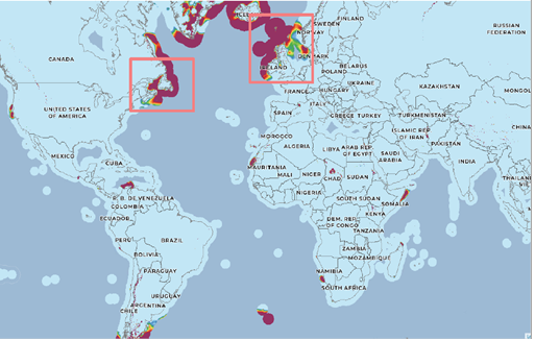
Source: Aegir Insights, Comparison of offshore wind resources in Atlantic Canada and the North Sea
The Great Lakes also offer significant potential for offshore wind, with an estimated 160 GW suitable for fixed-bottom turbines and an additional 415 GW for floating systems. This potential is driven by strong and consistent winds, which often exceed 9 metres per second. Beyond the Great Lakes, deep-water regions such as the Gulf of St. Lawrence and Canada’s Pacific coast are particularly well suited to floating offshore wind technology.
By 2050, Marine Renewables Canada hopes to see 30 GWs as described in the Sector Vision.
Progress Underway
Since 2022, the governments of Canada, Nova Scotia, and Newfoundland and Labrador have been working together to build an offshore wind industry in Atlantic Canada.
Important progress has already been made, including:
- New rules to manage offshore wind development in Nova Scotia and Newfoundland and Labrador.
- Regional Assesments in Nova Scotia and Newfoundland and Labrador.
- A land tenure process for offshore areas of joint management between federal and provincial governments.
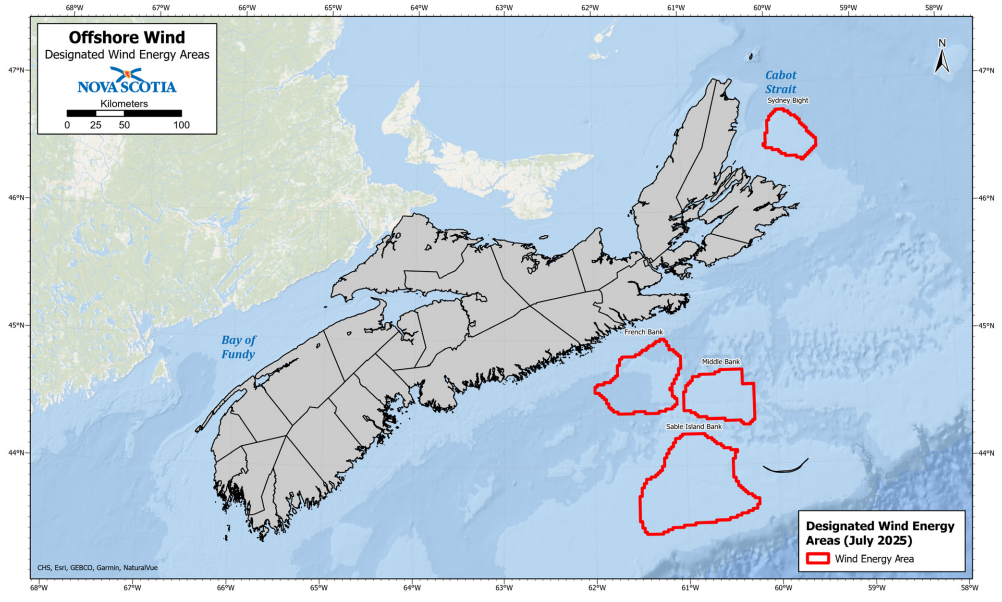 The Canada-Nova Scotia Offshore Energy Regulator (CNSOER) has designated four offshore wind energy areas off Nova Scotia’s coast and, following joint strategic direction from the federal and provincial governments, has formally initiated the process to issue a Call for Bids for offshore wind development. In October 2025, CNSOER launched the related Call for Information and pre-qualification process – a key step toward Canada’s first competitive offshore wind auction.
Offshore Wind Globally
Offshore wind is one of the fastest-growing sources of clean energy worldwide. As of early 2025:
- 300+ offshore wind farms are operating in 40+ countries.
- They produce about 83 GW of electricity – enough to power roughly 73 million homes (GWEC Global Offshore Wind Report 2025).
Offshore wind brings major economic benefits. In Europe, each gigawatt of offshore wind adds about USD 3.2 billion in economic value. That growth signals strong opportunities for Canadian businesses at home and abroad (GWEC, 2025).
Canadian companies and ports are already active in the global offshore wind market. Marine Renewables Canada has helped connect Canadian suppliers and marine service companies to projects around the world. MRC’s supply-chain study found that about 28% of Atlantic Canadian firms already have highly relevant skills for the offshore wind sector, a figure rising to over 60% when including those with partially applicable experience. This has and will create real opportunities for Atlantic Canadian businesses.
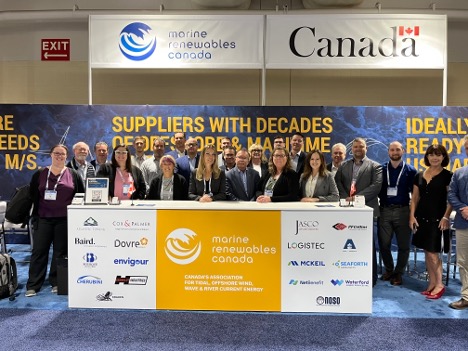
Canadian ports are already seeing new business. To date, Port of Argentia, Woodside (Port of Halifax), Port of Sheet Harbour, Port of Sydney, Atlantic Canada Bulk Terminal, Strait Superport, and Port Saint John have supported offshore wind logistics for US OSW projects based in Rhode Island, Virginia, Massachusetts, and New York.
As energy security becomes more important worldwide, offshore wind is also emerging as a strategic resource. It can help countries reduce dependence on fossil fuels and strengthen long-term energy independence.
Learn More
Offshore Wind – Government of Nova Scotia
Offshore Wind Energy – Natural Resources Canada
International Renewable Energy Agency
Canada – Nova Scotia Offshore Energy Regulator
https://www.energy.gov/eere/articles/wind-turbines-bigger-better