

- This event has passed.
Global Updates Webinar Series | Advancing Offshore Wind: Regional Updates & Insights from the Canary Islands Maritime Cluster
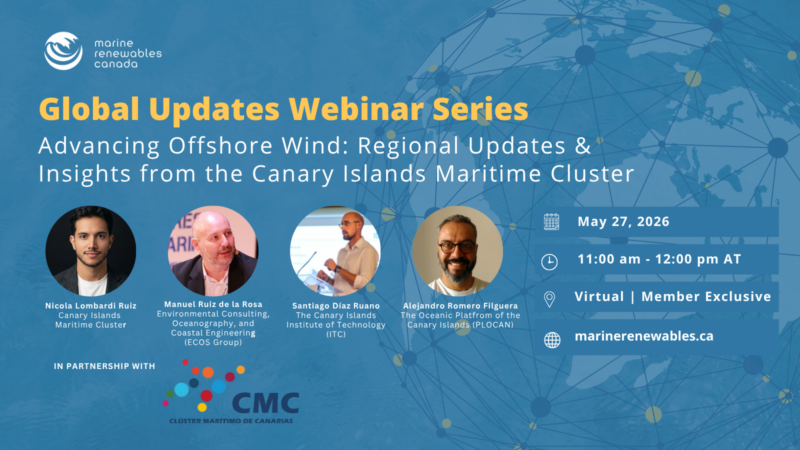
Join MRC for an engaging webinar in collaboration with the Canary Islands Maritime Cluster to explore the growing opportunities and strategic developments in the offshore wind and maritime sector in the region.
The Canary Islands are emerging as a key hub for offshore renewable energy, leveraging their unique geographic position, strong maritime expertise, and commitment to sustainability. This session will highlight how regional collaboration, innovation, and infrastructure are supporting the deployment of offshore wind projects in island and remote environments.
Participants will gain insights into:
- The role of maritime clusters in accelerating offshore wind development
- Key projects, capabilities, and supply chain opportunities in the Canary Islands
- Lessons learned and best practices applicable to other regions, including Atlantic Canada
- Opportunities for international collaboration and industry partnerships

Meet the Presenters:

Nicola Lombardi Ruiz, Project Manager – Canary Islands Maritime Cluster
Nicola Lombardi has been a Project Manager at the Canary Islands Maritime Cluster (CMC) since 2023. In this role, he manages innovation projects in the blue economy, overseeing project development, drafting deliverables, and supporting event organization and communication tasks. He is responsible for implementing various projects in which the CMC participates or leads, managing timelines, budgets, and work planning. He fosters partnerships across industry, government, universities, and civil society, ensuring effective stakeholder engagement and communications. Additionally, Nicola organizes working groups and events, planning the CMC’s involvement in sector events and trade fairs to enable maritime companies to collaborate, innovate, and grow.
Nicola holds a degree in Industrial Organization Engineering from the University of Las Palmas de Gran Canaria (2023). His Final Degree Project focused on the study of the capacities of the Puerto de la Luz, aimed at supporting the storage and equipment necessary for the assembly and manufacturing of floating renewable energy structures. This experience has given him deep knowledge of the port sector and floating offshore wind energy. He is also skilled in renewable energies, especially offshore wind and photovoltaic solar energy. Known for his adaptability and proactivity in learning, Nicola is committed to driving sustainable development in the maritime sector.
Manuel Ruiz de la Rosa, Director – Environmental Consulting, Oceanography, and Coastal Engineering (ECOS) Group
Manuel Ruiz de la Rosa is the co-founder and CEO of ECOS Estudios Ambientales y Oceanografía S.L. / Ecos Group, a Spanish environmental consultancy specialised in the marine environment, applied oceanography, environmental impact assessment, offshore monitoring and marine renewable energy. He has extensive experience leading multidisciplinary teams in the preparation of Environmental Impact Assessments, marine baseline studies, environmental monitoring programmes and permitting-related documentation for complex coastal, marine and energy projects. In the offshore wind sector, he has played a key role in positioning ECOS as a specialist provider of baseline studies and environmental monitoring services, including seabird and marine mammal surveys, benthic and sediment characterisation, water quality assessment, underwater noise, oceanographic studies, GIS analysis and impact assessment.
Manuel has also driven the development of ECOS’ Digital Aerial Surveys capabilities, integrating high-resolution imagery, LiDAR and AI-supported data processing to generate robust information on species distribution, abundance, density and bird flight heights for collision risk assessment. His profile combines strong technical knowledge of marine environmental assessment with strategic project leadership, regulatory understanding and international business development experience in demanding offshore wind markets.
 Santiago Díaz Ruano, Head of the Renewable Energy Section – The Canary Islands Institute of Technology (ITC)
PhD. Santiago Díaz Ruano has a Degree and Master’s in Electrical Engineering (University of Las Palmas de Gran Canaria, Spain) and PhD in Engineering in topics related to renewable energy forecasting and machine learning techniques (Doctoral Program of Chemical, Mechanical and Manufacturing Engineering, University of Las Palmas de Gran Canaria, Spain).
He has been working at the Canary Islands Institute of Technology (ITC) since 2012. Santiago has contributed to the elaboration of the Canary Islands Energy Planning. References: i: DOSE – Directrices de Ordenación del Sector Energético 2012 – 2020; ii) EECan25 – Canary Islands Energy Planning 2015-2025; iii) PTECan – Canary Islands Energy Planning 2021-2030; Energy strategies for PV self-consumption, energy storage, geothermal energy, marine energy, management generation, green hydrogen and demand side management). He also has collaborated in other insular energy planning such as in Galápagos Islands, Caribbean Islands and other European Islands.
 Alejandro Romero Filguera, Head of Research Line in Renewable Resources – Oceanic Platform of the Canary Islands (PLOCAN)
Alejandro Romero-Filgueira is an Electrical Engineer from 2005 and MSc in Renewable Energies. He developed his professional career from 2005 to 2019 in the energy sector as a Technical Consultant specialised in Predictive Maintenance and Commissioning in the electrical power system. In those years he became a senior expert in electrical machines diagnosis, specialised in power transformer life cycle management.
Alejandro Romero-Filgueira is currently employed as a R&D Project Manager in The Oceanic Platform of The Canary Islands, within the Renewables Research Line, where he was involved in H2020 funded project FLOTANT about Floating Offshore Wind as a Coordinator; and in H2020 funded project WATERTEYE about O&M tools for the Offshore Wind sector, MAESHA about the Smart Energy Management in isolated territories, HarhsMoP about sensoring in floating substructures, etc. He coordinates the activity of PLOCAN within the REMAR network and is the responsible of the Testing Infraestructure Harshlab 0.5 for testing materials in real sea conditions. He is the Coordinator of H2 Verde, which is part of the R&D Complementary Plans (PRTR) funded by EU Next Generation. This project aims to install an offshore electrolyser powerd by marine renewable energies and demonstrates the uses of the green hydrogen in the blue economy sector.