
Environment
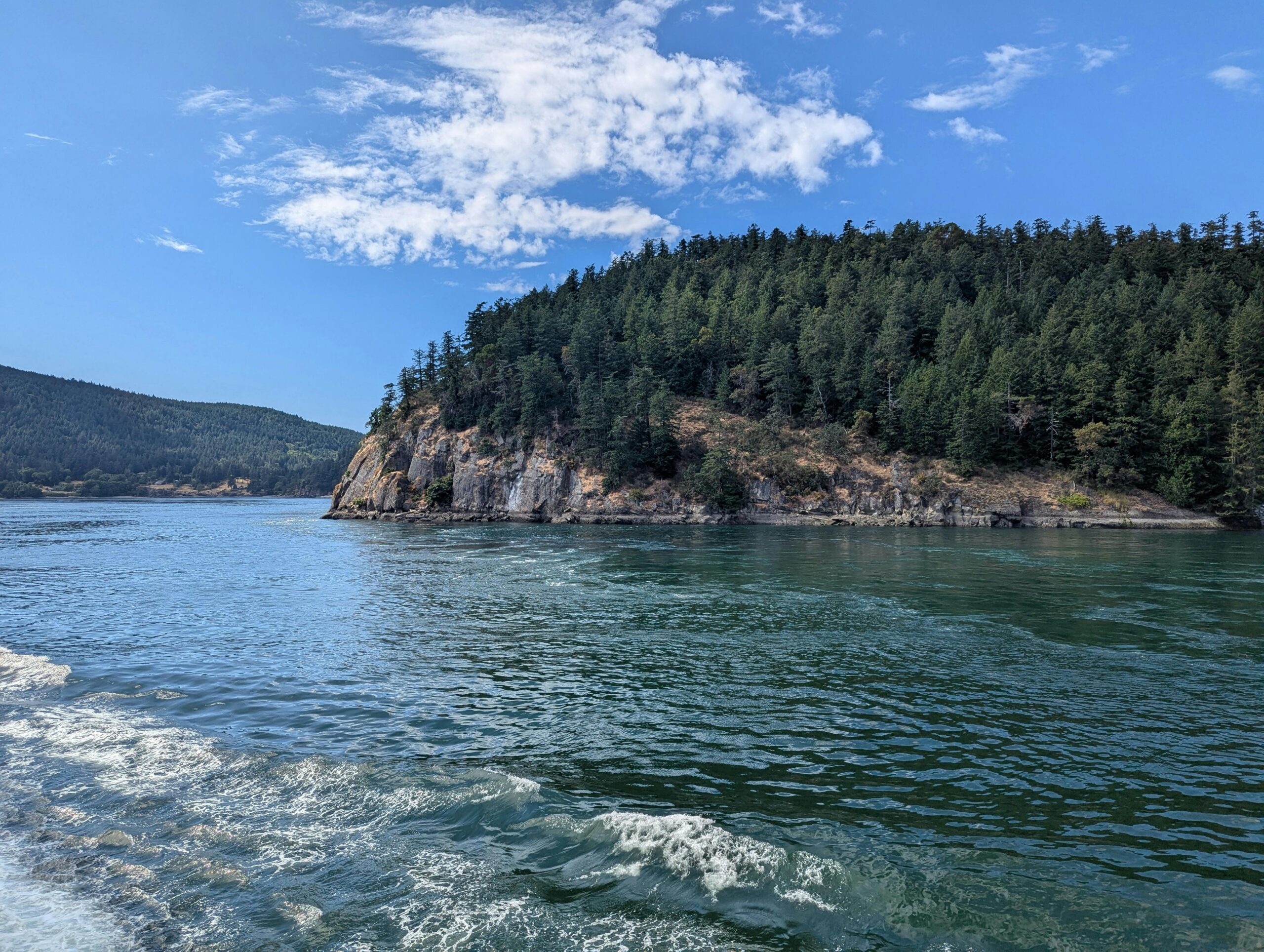
Did you know that about one in every three breaths we take is made possible by the ocean?
Or that people around the world consume more than 200 million tonnes of seafood every year, with roughly 500 million people relying on small-scale fisheries for their livelihoods?
The ocean is essential to life on Earth. It provides the air we breathe, the food we eat, and the jobs and cultures that sustain coastal communities. Today, however, this vital life-support system is under growing pressure from climate change.
Climate Change and the Ocean
Climate change is closely linked to rising carbon dioxide levels in the atmosphere. As more greenhouse gases are released through the burning of fossil fuels, the planet warms. The ocean absorbs much of this excess heat and carbon, leading to warmer waters and increasing ocean acidity.
These changes are already affecting marine life. Warmer, more acidic waters are shifting where fish and other species can live, altering food webs and disrupting fishing patterns. Rising temperatures can also increase the spread of disease and parasites, making it harder for marine species to survive. Reducing greenhouse gas emissions is essential to slow these changes and protect healthy, productive ocean ecosystems.
Climate change also affects people directly. Increasing heat, worsening air quality, freshwater shortages, and the spread of disease are already being felt around the world. Each year, an estimated 6.7 million deaths are linked to air pollution – a number expected to rise unless the global energy system shifts toward cleaner sources (World Health Organization).

Marine Renewable Energy and the Environment
Marine renewable energy uses the power of offshore wind, tides, waves, and river currents to generate electricity without releasing greenhouse gases. By reducing emissions, these technologies help slow climate change and support long-term ocean health.
Like all energy development, marine renewable energy interacts with the environment. Potential impacts are generally low, and can be carefully managed and mitigated through research, planning, ongoing monitoring, and adaptive management measure such as:
Site selection
Projects are designed to avoid sensitive habitats, migration routes, and important feeding areas.
Technology design
Tidal turbines are inherently slow-rotating compared to technologies like boat propellers, and across a range of designs are engineered to minimize turbulence, reduce noise, and are closely monitored for impacts to marine life.
Monitoring and adaptation
Continuous environmental monitoring allows operators to adjust construction and operations to protect marine species as new information becomes available.
Offshore Wind
Offshore wind farms can have both positive and negative environmental effects. Over time, turbine foundations can act as artificial reefs, creating new habitat for species that prefer hard, rocky surfaces. Scientists have observed distinct layers of marine life developing at different depths – similar to natural coastal reefs. Barnacles often grow near the surface, mussels attach in shallower waters, and sea anemones and small crustaceans are found deeper down.
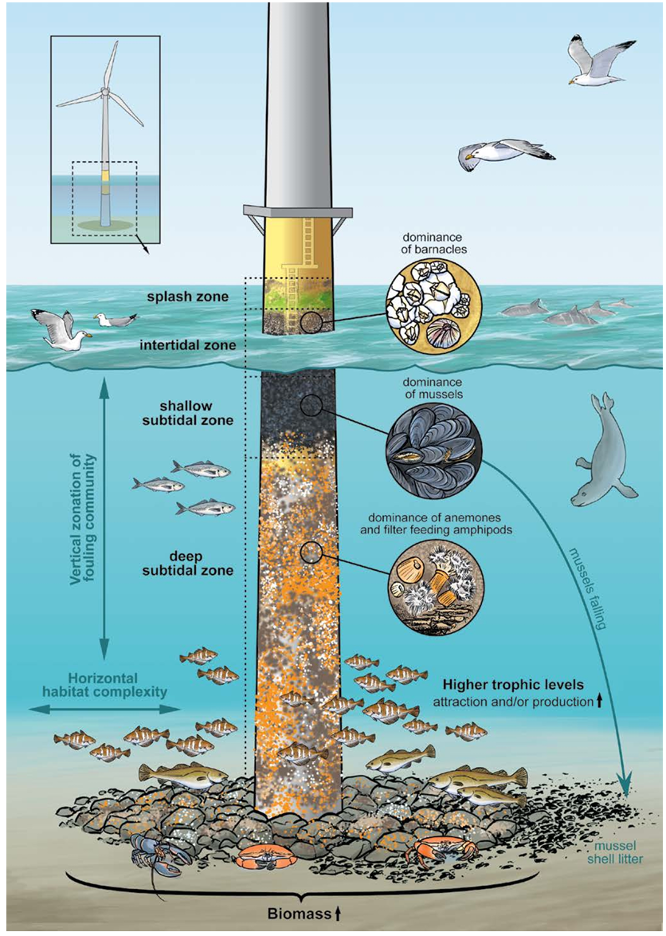
Offshore Wind Farm Artificial Reefs Affect Ecosystem Structure and Functioning: https://tethys.pnnl.gov/sites/default/files/publications/Degraer-et-al-2020-Artificial-Reefs.pdf
Many of these organisms are filter feeders, removing tiny particles from the water column. This can improve water clarity, allowing more sunlight to reach the water and supporting the growth of marine plants and algae. As these species grow, they also add nutrients to the seabed – much like fertilizing soil on land – attracting larger species such as Atlantic cod and lobster that use the rocky structures for shelter.
In some cases, studies suggest that offshore wind farms can support higher concentrations of marine life than surrounding areas. Similar to marine protected areas, this can even lead to increased fishing opportunities outside the wind farm footprint.
However, offshore wind farms present potential environmental risks. During site surveys and construction, underwater noise may disturb marine mammals such as whales and dolphins. Birds and bats may be affected by turbines, particularly during migration. A growing body of international research examines these risks and continues to inform mitigation measures such as careful siting, seasonal construction limits, monitoring, and ongoing improvements in turbine design to reduce potential impacts.
Debunking Myths
Myth: Offshore wind turbines are a major cause of bird deaths.
Fact: In Canada, collisions with buildings and windows are estimated to kill about 16 million to over 40 million birds each year, making it one of the largest human-related sources of bird mortality. In contrast, deaths from wind turbine collisions are much lower, with studies estimating roughly 20,000–23,000 birds per year from collisions at existing wind farms nationwide. Researchers continue to study effective ways to reduce this number further, with a study finding that painting one blade black reduces bird fatalities by roughly 70%!
Myth: Offshore wind causes mass whale deaths.
Fact: There is no evidence linking offshore wind farms to mass whale mortality. Most whale deaths are caused by vessel strikes and entanglement in fishing gear, which account for tens of thousands of deaths globally each year.
Tidal Energy
Tidal energy systems interact with the marine environment in several ways, including flow dynamics, seabed conditions during deployment, sound, and marine life distribution and behaviour. A key area of research examines how tidal turbines may affect fish and marine mammals. Although turbines present potential collision risk, studies using fish tagging, cameras, sonar, and acoustic sensors show that many species naturally avoid turbines.
The global evidence is encouraging. Over more than 15 years of international research, the few documented fish interactions have not shown obvious harm, and marine mammals have continued normal movement and behaviour around at least one long-term turbine installation. Risks from small deployments – such as changes to habitat, local oceanographic conditions, underwater noise, and electromagnetic fields – are considered low enough to be effectively retired for early-stage projects.
Continued monitoring remains essential. As turbines operate in the Bay of Fundy and at other tidal sites, ongoing assessment will help confirm these findings under local conditions, verify that risks remain low as projects scale, and ensure our understanding keeps pace with advancing technology.

An underwater acoustic camera captures a harbor seal interacting with a tidal turbine in Washington state’s Sequim Bay. Image Credit: Pacific Northwest National Laboratory
Debunking Myths
Myth: Tidal turbines are deadly to fish and marine mammals.
Fact: Monitoring at tidal energy sites shows that most fish and marine mammals avoid turbines. Because water is denser than air, turbines naturally rotate slowly (5-20 RPM). This slow rotation combined with careful placement in high-flow areas helps reduce collision risk. For example, a recent study using underwater cameras to track animal interactions with a small tidal turbine in Washington state found no collisions with seals or seabirds and a high rate of fish safely avoiding the turbine, providing early empirical evidence that many marine animals can coexist with operating tidal devices (Inside Climate News).
Myth: Tidal energy disrupts ocean currents and ecosystems.
Fact: Tidal devices capture only a small fraction of the energy in moving water. Studies from experts at Acadia Tidal Energy Institute show that changes to currents and sediment movement are very small compared to natural tidal forces.
Wave Energy
Many wave energy devices are at or near the ocean surface (e.g., point absorbers, attenuators), and don’t rely on fast-moving underwater parts. As a result, potential impacts on fish, marine mammals, and seabirds are generally low. Operational noise is minimal, further reducing disturbance.
Wave energy projects can cause small changes in local wave patterns, but these effects are carefully studied and limited in scale. In some locations, wave devices may even help reduce coastal erosion by absorbing wave energy before it reaches the shore (ScienceDirect).
Wave energy captures a very small fraction of the ocean’s naturally occurring energy, relative to the vast energy available in the marine environment. Devices are designed to coexist with shipping, fishing activities, and marine habitats through careful siting and ongoing monitoring.
River Current Energy
River current energy systems generate electricity from flowing water without blocking or restricting the natural movement of rivers. Environmental considerations include the potential risk of collisions with aquatic animals, noise that could affect communication or behavior, and electromagnetic fields from power cables.
Modern turbine designs minimize turbulence and operate at slow rotational speeds, helping aquatic species pass safely. Research shows that these systems do not significantly disrupt fish migration or alter river ecosystems when properly designed and sited.
Debunking Myths
Myth: River current energy stops fish migration.
Fact: Well-placed turbines allow fish to pass safely and do not block natural movement.
Myth: River current energy significantly changes river ecosystems.
Fact: Potential impacts are localized and minor when projects use modern designs and appropriate siting
Learn More
• Fundy Ocean Research Centre for Energy (FORCE)
Publishes regular environmental monitoring reports for its site in the Bay of Fundy prepared with research partners.
• Ocean Energy Systems – Environmental
Synthesizes and disseminates information and research on the environmental effects of marine renewable energy at a global scale.
• Acadia Tidal Energy Institute
Provides a variety of services related to tidal energy development such as research and public and professional education on all of the Institute’s core areas of work and outreach.
• NOAA – Ocean & Climate Change
Explains how the ocean regulates climate, absorbs heat and carbon, and how warming and acidification affect marine ecosystems.
• World Health Organization – Air Pollution
Data and explanations on air pollution, health impacts, and links to fossil fuel use.
• Tethys – Marine Renewable Energy Research
Database of Environmental Impacts of Offshore Wind and Marine Renewable Energy.